
Honda x Shigeya Miyata: Engineering immobilized in design objects.
- Helena Dezem

- Jan 19
- 2 min read
In the Pause series, Shigeya Miyata explores the immobility of Honda parts as a repurposing strategy, transforming discontinued motorcycle components into functional objects molded in concrete.

The Pause series, by Japanese designer Shigeya Miyata, consists of functional objects created from repurposed discontinued Honda motorcycle components, fixed to concrete structures. The project stems from a simple and deliberate operation: removing parts designed for continuous movement and placing them in a permanent state of immobility.
Automotive components typically exist only as functioning systems. Their design responds to stress, rotation, impact, and displacement. When cast in concrete, these elements lose their mechanical function and begin to operate as visible matter. The concrete acts as a static base, interrupting movement and physically supporting parts that previously depended on constant action.
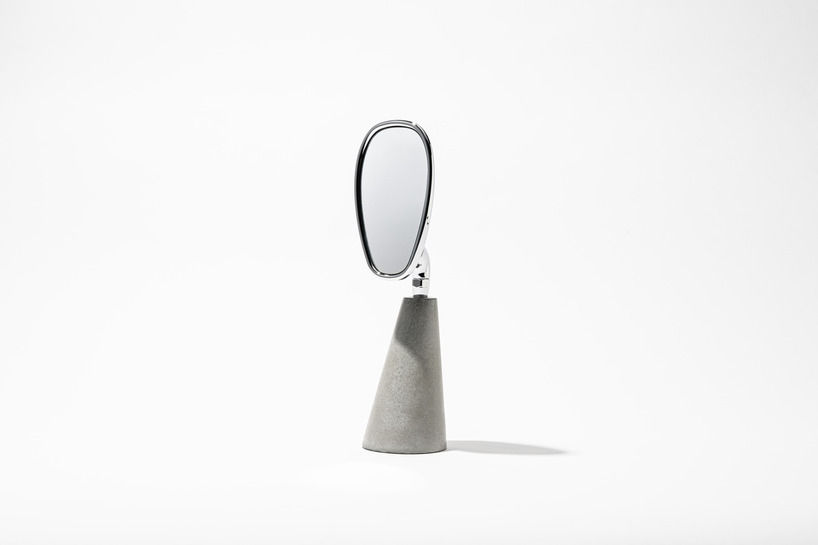
This contrast organizes the entire series. On one hand, precision engineering, designed to operate together and, generally, out of sight. On the other, a solid mass that fixes, exposes, and redefines the role of these parts. Once incorporated, the components cease to be hidden parts of a larger system and begin to exist as autonomous elements, legible in their form, finish, and manufacturing method.
The series includes mirrors, vases, pen holders, and picture frames. Each object is created directly from specific components of different Honda models. The mirror is produced in two editions and uses parts from the VT1300CX. The vase appears in eleven editions, molded from components of the CBR250RR. The pen holder and picture frame are limited to three editions each, both constructed with parts from the RC213V-S model. The quantity is not arbitrary; it reflects the actual availability of the original components.

All objects are produced manually. Miyata oversees the entire process, from the development of the molds to the final casting in concrete. There is no attempt to mask the industrial origin of the pieces or to soften their presence. The project preserves marks, joints, and geometries typical of engineering, now displaced to a domestic context.

Pause was developed as part of uppar, Honda's upcycling initiative focused on reusing discontinued parts in non-automotive applications. Within this context, the series moves away from generic interpretations of sustainability and concentrates on material continuity. Reuse occurs without erasing the technical history of the parts, nor transforming them into mere decorative elements.
Situated between design and art, the series investigates how function, value, and material identity can be reorganized when movement is suspended. By fixing engineering components in a permanent state of rest, Miyata proposes another form of reuse. One that preserves precision, visibility, and materiality, even outside its original system.

Images: Shigeya Miyata
Source: Designboom


Comments